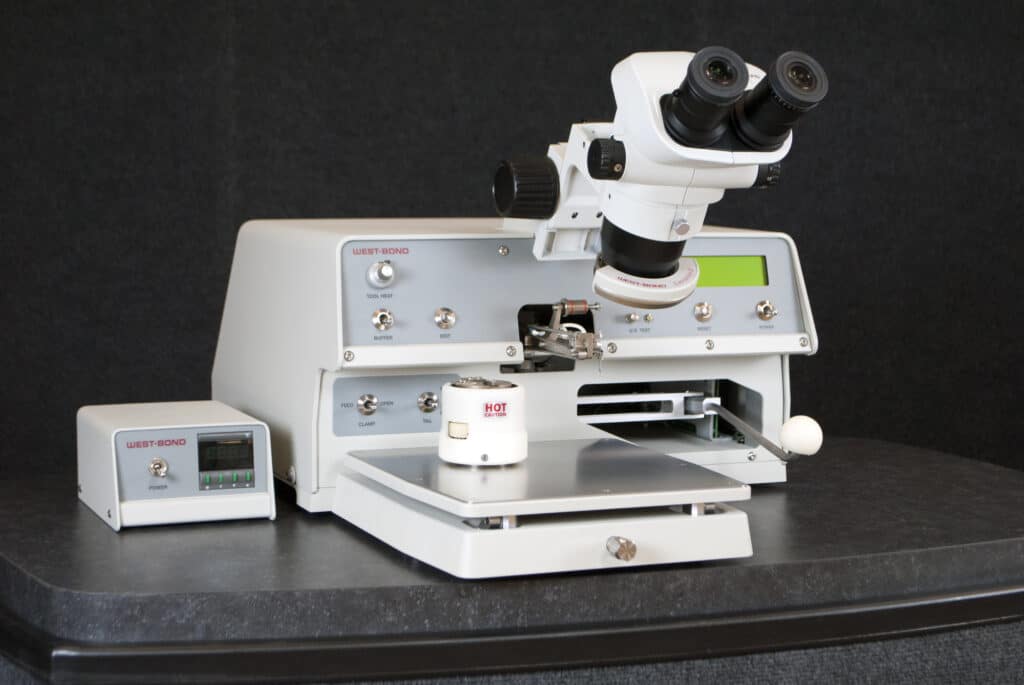
West-Bond 7700D Wire Bonder
A manual thermosonic ball-wedge wire bonder designed for precision microelectronic packaging. It utilizes ultrasonic energy and heat to create reliable gold wire interconnections between semiconductor dies and package leads.
System Capabilities
The West-Bond 7700D is a manual workstation that gives operators fine control over the interconnection process. It uses an 8:1 mechanical advantage manipulator, allowing for precise placement of ball and wedge bonds on micron-scale pads.
This system is specifically optimized for Thermosonic Bonding, combining ultrasonic energy with a heated stage (typically 100°C - 150°C) to form strong metallurgical bonds without damaging sensitive die structures.
Operating Modes
Ball-Wedge Bonding
Standard mode for connecting device pads (Ball) to package leads (Wedge) using Gold wire.
Manual XYZ Control
Operator-guided motion for repairing traces or bonding prototype devices with irregular layouts.
Stitch Bonding
Creating continuous chains of interconnects between multiple points on a hybrid assembly.
Programmable Logic
Onboard CPU stores specific power, time, and force settings for consistent repeatability.
Technical Specifications
| Bonding Method | Thermosonic (Heat + Ultrasonic) |
|---|---|
| Wire Compatability | Gold (0.7 - 2.0 mils diameter) |
| Ultrasonic Transducer | 63 kHz, 5W Dual-Channel |
| Z-Axis Travel | 0.5 inches |
| Throat Reach | 5.125 inches |
| Microscope | Stereo Zoom (External) |
Comparison: Wire Bonding vs. Soldering
Comparing thermosonic gold wire bonding against traditional electronics soldering methods.
| Feature | This Tool (Wire Bonding) | Traditional (Soldering) |
|---|---|---|
| Connection Scale | Micron Scale (~25 µm) | Millimeter Scale |
| Material | Pure Gold Wire | Lead/Tin Alloy Paste |
| Temperature | Localized Ultrasonic + Heat | Global Reflow / Direct Iron |
| Application | Die-to-Package (Inside Chip) | Component-to-Board (PCB) |
| Reversibility | Permanent | Reworkable |