Fischione 1051 TEM Ion Beam Mill
Ion milling and polishing system for preparing electron-transparent TEM specimens. Dual ion sources, wide energy control, and adjustable incidence angles support fast thinning and low-damage final polishing.
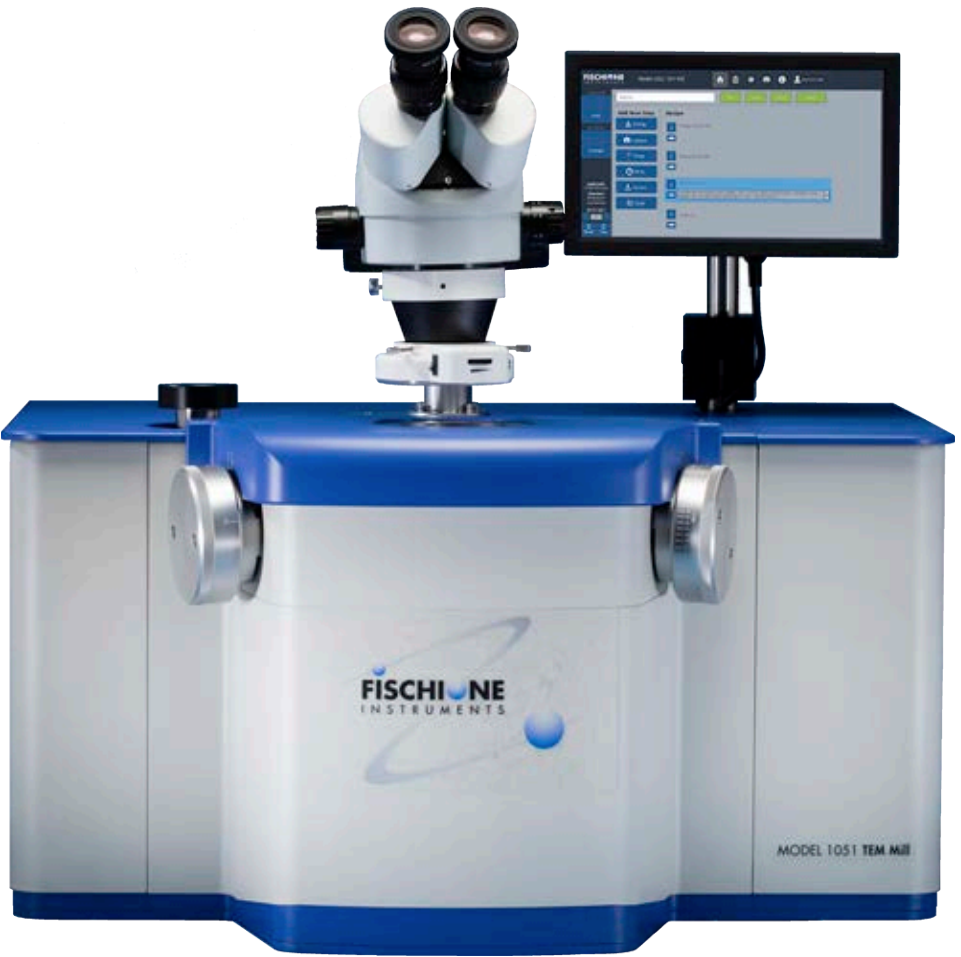
System Capabilities
The 1051 TEM Mill prepares thin, electron-transparent specimens using dual ion sources with independently controlled energy. It supports high-rate material removal for bulk thinning and low-energy polishing for final surface cleanup.
Adjustable incidence angles, 360-degree rotation with rocking, and beam sequencing help control uniformity and reduce preferential milling. Optional cryogenic cooling is available for temperature-sensitive materials.
Operating Modes
High-Energy Milling
Ion energies up to 10 keV for rapid thinning from bulk to near electron transparency.
Low-Energy Polishing
Ion energies down to about 100 eV for final cleanup and damage reduction.
Double-Sided Milling
Beams directed to both surfaces for symmetric thinning and reduced redeposition.
Automated Recipes
Multi-step sequences with energy, angle, time, and temperature control for repeatable runs.
Technical Specifications
| Ion Sources | Two TrueFocus ion sources, independently controlled |
|---|---|
| Ion Energy | ~100 eV to 10 keV (variable) |
| Beam Current Density | Up to ~10 mA/cm^2 |
| Milling Angle | -15 to +10 deg incidence |
| Specimen Size | Approx. 3 mm diameter x 250 um thick |
| Stage Motion | 360 deg rotation, variable speed, rocking and beam sequencing |
| Process Gas | Ultra-high purity argon (99.999%), ~15 psi |
| Cooling (Optional) | LN2 conductive stage, standard 3-5 h dewar (extended 12-18 h) |
| Power | 100/120/220/240 VAC, 50/60 Hz, ~720 W |
Comparison: Ion Milling vs. Mechanical Pre-Thinning
Comparing the ion beam mill to traditional mechanical pre-thinning and dimpling approaches.
| Feature | This System (Ion Milling) | Traditional Method (Mechanical) |
|---|---|---|
| Material Removal | Argon ion beam thinning and polishing | Abrasive grinding and dimpling |
| Process Role | Final step to reach electron transparency | Pre-thinning to reduce ion milling time |
| Damage Control | Low-energy polishing to reduce prep damage | Mechanical steps can introduce surface damage |
| Angle Control | Precise incidence angle and beam sequencing | Limited to fixture and wheel geometry |
| Best Use | Final thinning for TEM/STEM readiness | Bulk material removal before ion milling |