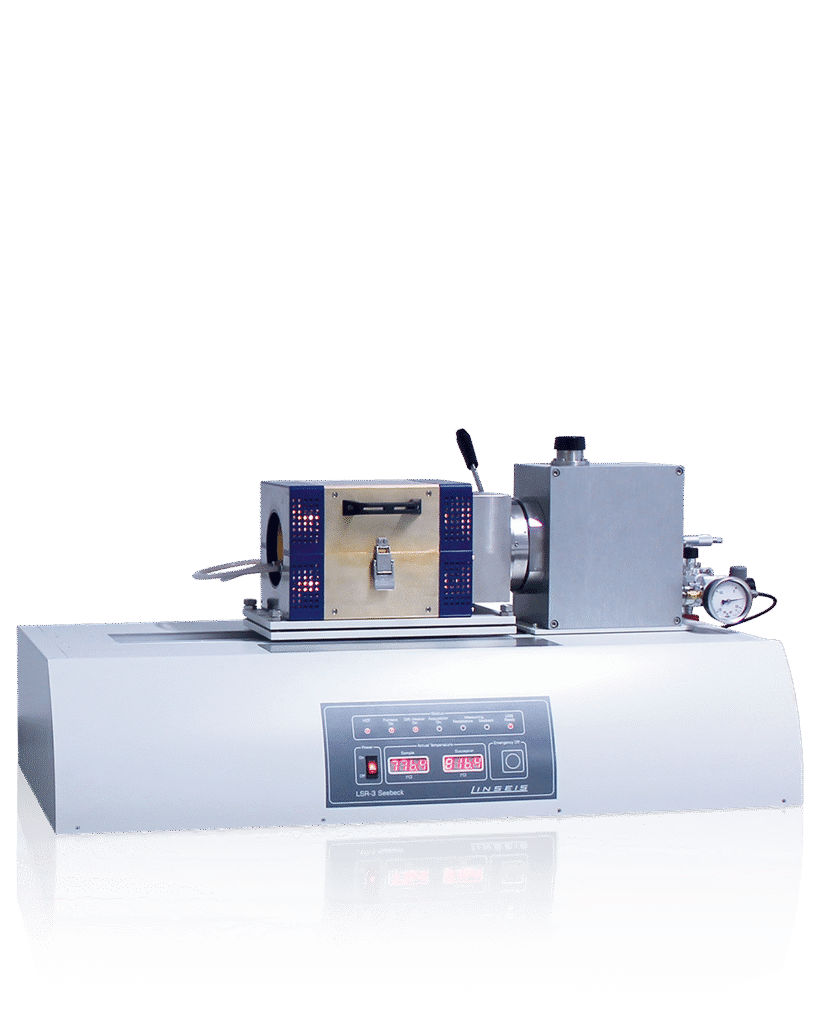
LINSEIS LSR-3 Seebeck & Resistivity Instrument
Simultaneous measurement of Seebeck coefficient and electrical resistivity for thermoelectric materials. Supports bulk and thin-film samples across a wide temperature range and multiple atmospheres.
System Capabilities
The LINSEIS LSR-3 measures Seebeck coefficient and electrical resistivity in a single setup, enabling fast thermoelectric characterization. It supports bulk, rod, and disc samples plus thin films using dedicated adapters.
Exchangeable furnaces enable measurements from sub-ambient temperatures to high-temperature configurations, and tests can be performed in inert, oxidizing, reducing, or vacuum environments.
Operating Modes
Seebeck Coefficient
Thermoelectric voltage vs. imposed temperature gradient.
Resistivity (4-Terminal)
DC four-terminal method for accurate resistivity and conductivity.
High-Resistance Option
Extended range for low-conductivity and semiconducting samples.
Thin-Film Adapters
Dedicated holders for films and foils on substrates.
Technical Specifications
| Temperature Range | Approx. -100 C to 500 C; up to 1500 C with furnace options |
|---|---|
| Sample Sizes | Bars/cylinders 6-23 mm length; discs 10, 12.7, or 25.4 mm |
| Seebeck Measurement | Static gradient / slope method with dual thermocouples |
| Resistivity Measurement | DC four-terminal method, 0-160 mA source (optional 220 mA) |
| Atmospheres | Inert, oxidizing, reducing, or vacuum |
| Software | Windows control, acquisition, and export to ASCII/Excel |
Comparison: This System vs Conventional Alternative
A high-level comparison to highlight performance and workflow advantages.
| Feature | This System | Conventional Method |
|---|---|---|
| Precision | Higher accuracy and repeatability | Standard tolerance |
| Workflow | Streamlined and automated | Manual or multi-step |
| Throughput | Faster turnaround | Slower cycle time |