NIL Technology Compact Nano Imprinter v3.0
A compact nanoimprint and hot-embossing tool for replicating micro- and nanoscale structures from a master stamp into polymers or resists. Supports thermal NIL, UV NIL, and hot embossing for rapid prototyping and small-scale production.
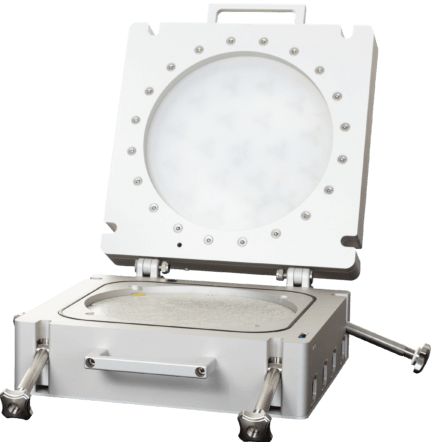
System Capabilities
The CNI v3.0 is a desktop nanoimprint tool that supports thermal NIL, UV NIL, and hot embossing. It replicates micro- and nanoscale features from a master stamp into polymer or resist layers.
The system can run in atmospheric or vacuum conditions and supports chamber sizes up to 120 mm or 210 mm, depending on the configuration installed.
Operating Modes
Thermal NIL
Imprint at elevated temperature for thermoplastic resists.
UV NIL
UV curing at 365 nm and/or 405 nm for UV resists.
Hot Embossing
Emboss polymer substrates with micro- and nanoscale patterns.
Vacuum Imprint
Optional vacuum imprinting to reduce trapped air and defects.
Technical Specifications
| Tool Type | Desktop nanoimprint and hot-embossing tool |
|---|---|
| Technologies | Thermal NIL, UV NIL, hot embossing, micro-contact printing, polymer bonding |
| Temperature Range | Up to 250 C (thermal), up to 200 C with UV lids |
| Pressure Application | Membrane-based uniform pressure up to about 6.5 bar |
| Atmosphere | Atmospheric or vacuum (~1 mbar) |
| Feature Size Range | Approx. 40 nm to >100 um (master dependent) |
| Chamber Size | 120 mm or 210 mm diameter chamber options |
| Operation | Manual load/unload with automatic process control |
| Footprint | Compact desktop system (about 1 m2) |
Comparison: Nanoimprint vs. Photolithography
Comparing nanoimprint replication against a traditional photolithography workflow.
| Feature | Nanoimprint (CNI) | Photolithography |
|---|---|---|
| Pattern Transfer | Mechanical imprint from a master stamp | Optical exposure through a photomask |
| Resist Types | Thermoplastic or UV-curable imprint resists | Photoresists (positive/negative) |
| Equipment Footprint | Compact desktop tool | Typically larger fabrication tools |
| Replication Method | Stamp reuse for repeated patterns | Mask-based exposures |
| Best For | Rapid replication and prototyping | Standard optical lithography workflows |