Microtrac BELSORP MAX X Surface and Pore Analyzer
High-precision gas and vapor sorption analyzer designed for surface area and pore size distribution (0.35-500 nm) measurements along with vapor sorption studies.
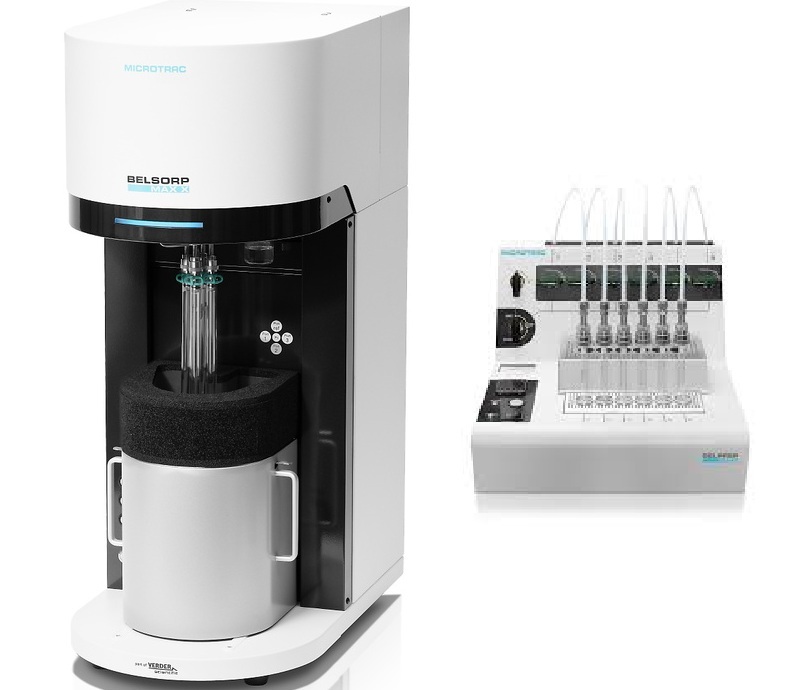
System Capabilities
The BELSORP MAX X measures adsorption isotherms for surface area (down to 0.1 m2/g with N2 and 0.0005 m2/g with Kr) and pore size distribution across ultra-micro to mesopores (0.35-500 nm). It supports water vapor sorption for hydrophilicity studies and organic sorption.
AFSM (Advanced Free Space Measurement) technology compensates for free space changes, improving accuracy for samples and ultra-microporous materials to advance nanoscale R&D characterization.
Operating Modes
High-Precision Mode
Reference port tracking for maximum accuracy.
Multi-Sample Mode
Run up to four samples for higher throughput.
Quick BET Mode
Rapid three-point BET measurements for screening.
Vapor Sorption
Isotherms for water vapor and organic vapors (Upon request).
Technical Specifications
| Measurement Principle | Volumetric/manometric with AFSM |
|---|---|
| Pressure Transducers | 133 kPa, 1.33 kPa, 0.0133 kPa ranges |
| High Pressure Model | Up to 1 MPa (MAX X HP) |
| Low types | Turbo pump, 10-8 P/Po, molded bodies |
| Software | BELMaster, BELControl with advanced GCMC/NLDFT pore analysis alongside traditional BET / BJH calculations |
| Sorbates | N2, W2, Water vapor (Ar, Kr, organic vapor available at request with method development.) |
Comparison: This System vs Conventional Alternative
A high-level comparison to highlight performance and workflow advantages.
| Feature | This System | Conventional Method |
|---|---|---|
| Precision | Higher accuracy and repeatability | Standard tolerance |
| Workflow | Streamlined and automated | Manual or multi-step |
| Throughput | Faster turnaround | Slower cycle time |